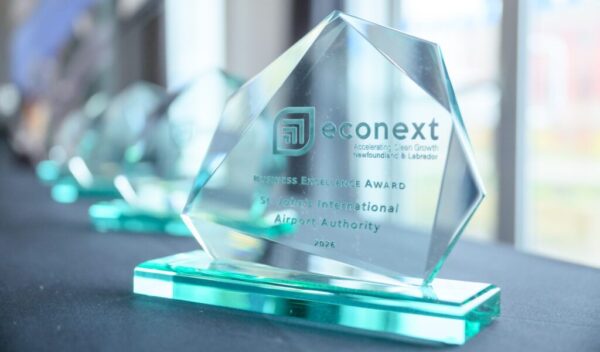
Long-Time Client Wins Award!
St. John’s International Airport Authority (SJIAA) was awarded econext’s Business Excellence Award this year! Fundamental Inc. has been working with ...
Read MoreReflection by Astrid Arumae:
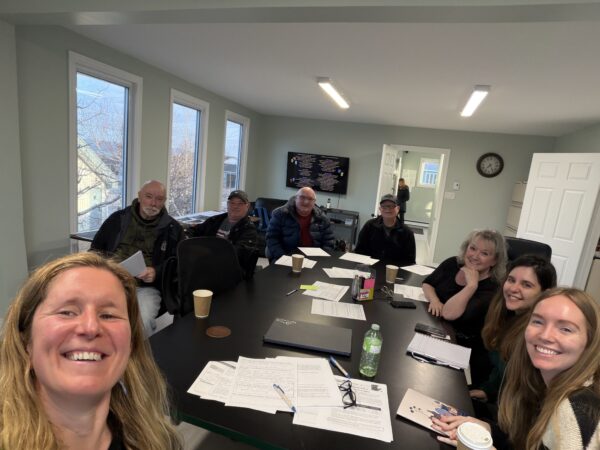
I spent the past two weeks on the road with my colleagues from Fundamental Inc. on Kittiwake coast leading public sessions on climate risks and vulnerabilities to support adaptation work in small rural municipalities in Newfoundland and Labrador.
We all know that advancing climate action in our communities has been a real challenge since the pandemic. The climate movement was getting the attention and engagement it needed back in 2019. A lot has changed since then. Whether you’re in the community, non-profit, consulting or municipal space, climate action has been pushed back and down as other priorities and crises are being moved up. Powerful forces are pulling us and our communities in many directions at once – health, housing, food security and affordability crises, the widening inequality gap, the weakening of social connections and coherence and the lack of political will and support for climate priorities and action.
Yet, the increasing frequency and intensity of climate change impacts such as more violent storms and sea levels never been seen before, the changes in the wind and temperature, the worst wildfire season (2025) to date in the province (NL) and the confluence of inland and coastal flooding producing scenarios that the communities are not prepared for just to name ‘a few’, is reminding us that we really need to awaken to the truth of all of what we see around us. The crises around us are not separate from climate change, they are all interconnected and interdependent affecting our lives daily.
What people do locally in their communities to encourage sustainability and change, the good people who volunteer their time as Town Councillors, the Mayors and town staff who show up to do this work, is the local leadership that we need to move this critical work forward to protect our communities. This is the end of the line but this is also where we get started.
Our ‘roadshow’ of public sessions on Climate Risks and Vulnerabilities as part of the Local Leadership for Climate Adaptation (LLCA), a Federation of Canadian Municipalities program of the Green Municipal Fund, took us to Gambo, Hare Bay, Dover, Indian Bay and Centreville-Wareham-Trinity in Newfoundland and Labrador.
Everywhere we went, we asked these 8 questions:
🌱 What might we do as a community to make us more resilient to climate change?
🌱 How do we connect with and depend on the land and water here?
🌱 What is important to us? What do we care about in our community?
🌱 What is unique about our community? What do we love about this place?
🌱 What strengths and knowledge do we have here that we can build upon?
🌱 What would we like the future our community to look like?
🌱 How do we get there? What could we do?
🌱 What makes doing these things difficult? What do we need help with?
And everywhere we went we met so many people who care. They care about what happens.
When asked in one of the sessions on how they connect with the land and water there, what we heard was : “ We are as one.”
We often hear stories of how much the people of Newfoundland and Labrador feel connected to this place and the love and sense of belonging they have – these four words capture it well.
We also heard frustration over the decades longstanding issue of lack of access to safe drinking water which all of these communities and most other places in Newfoundland and Labrador still continue to face and climate change is impacting the already fragile water infrastructure. The personal and environmental cost to residents to depend on bottled water and local springs where available, is something people have just had to ‘adapt to’ but this should not be so.
I was so inspired to hear an idea that sprouted in one of the communities we talked with – “What about a community artesian well?!”. A project that could be a joint cost-share venture with a neighboring town since they already share the current water supply. While fixing the issues with current water supply require millions in capital funding, creating a community artesian well seemed a project that is doable and not out of reach.
Other ideas included creating a Community Response Team (emergency preparedness and response), doing our own Fire Smart property assessments, starting committees to do research and self-organize around issues, planting more trees and water-hungry species like willow by the shoreline to help with erosion, setting up free community wifi zone to help with the lack of cellular signal in most areas, installing solar panels, converting generators to run on vegetable oil, to growing more food locally, to more sharing of critical knowledge for emergency preparedness, storms, wildfires and climate change.
All of this made me think of what Margaret Wheatley has said: “ Whatever the problem. Community is the answer”. And I truly believe that. I see it in action wherever I go.
While our discussions brought up difficult feelings of being somewhat trapped by current political, financial and general resource constraints or how climate science is still disconnected from the provincial and federal servicing and local measures, we focused on things we can do and can change. And I just loved that about all the folks we had the honour to meet and sit down with and my heart is full of gratitude, inspiration and hope. It’s not the kind of hope where we think that positive thinking will just get us there but it’s the kind of hope where we know we must do this even when it’s hard, even when it seems impossible, because we know it’s worth doing no matter what.
St. John’s International Airport Authority (SJIAA) was awarded econext’s Business Excellence Award this year! Fundamental Inc. has been working with ...
Read More
Fundamental Inc. is officially 10 years old! 🎉 Over 50 communities across Atlantic Canada have made progress on their climate ...
Read More
On February 26th, 2026, Emma shared some of what we’ve seen and heard in our work lately with Adam Walsh ...
Read More
Most people probably don’t associate heat with Newfoundland and Labrador very much, but we’re seeing hot days more and more ...
Read More
We’re celebrating a milestone! Our small but mighty team has surpassed $20 million in total awarded funding for climate action ...
Read More
The Town of Channel-Port Aux Basques has had a rough few years after the devastation of Hurricane Fiona – they ...
Read More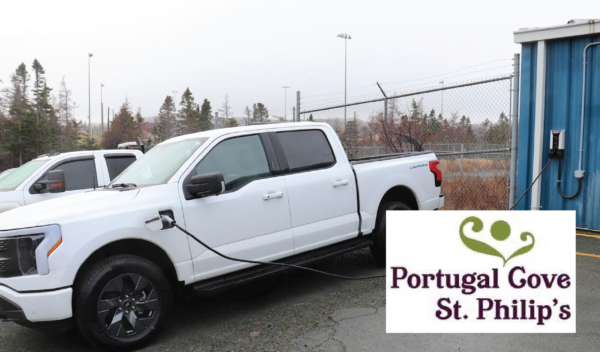
We are so proud to have contributed to this fleet electrification project with the Town of Portugal Cove – St. Philip’s. ...
Read More
On January 24th, 2024, Emma represented Fundamental Inc. on a climate change-focused panel discussion hosted by Statistics Canada and The Harris Centre. It ...
Read More
On the November 22nd episode of Municipal Matters on Rogers Community TV, Ashley was featured as part of a panel ...
Read More It has been a full year since Hurricane Fiona devastated the Southwest Coast of the Island of Newfoundland, specifically the ...
Read More